Why is my C chord muted?
The index or middle finger usually leans into a neighbouring open string. Test one string at a time before pressing harder.
Quick answer
A muted C chord usually comes from one finger touching a neighbouring string. Curl the fingertips, move close behind each fret, and pick A through high E separately.
- Do not strum the low E string
- Check the open G and high E strings
- Curl the index finger away from high E
Real C chord hand shape
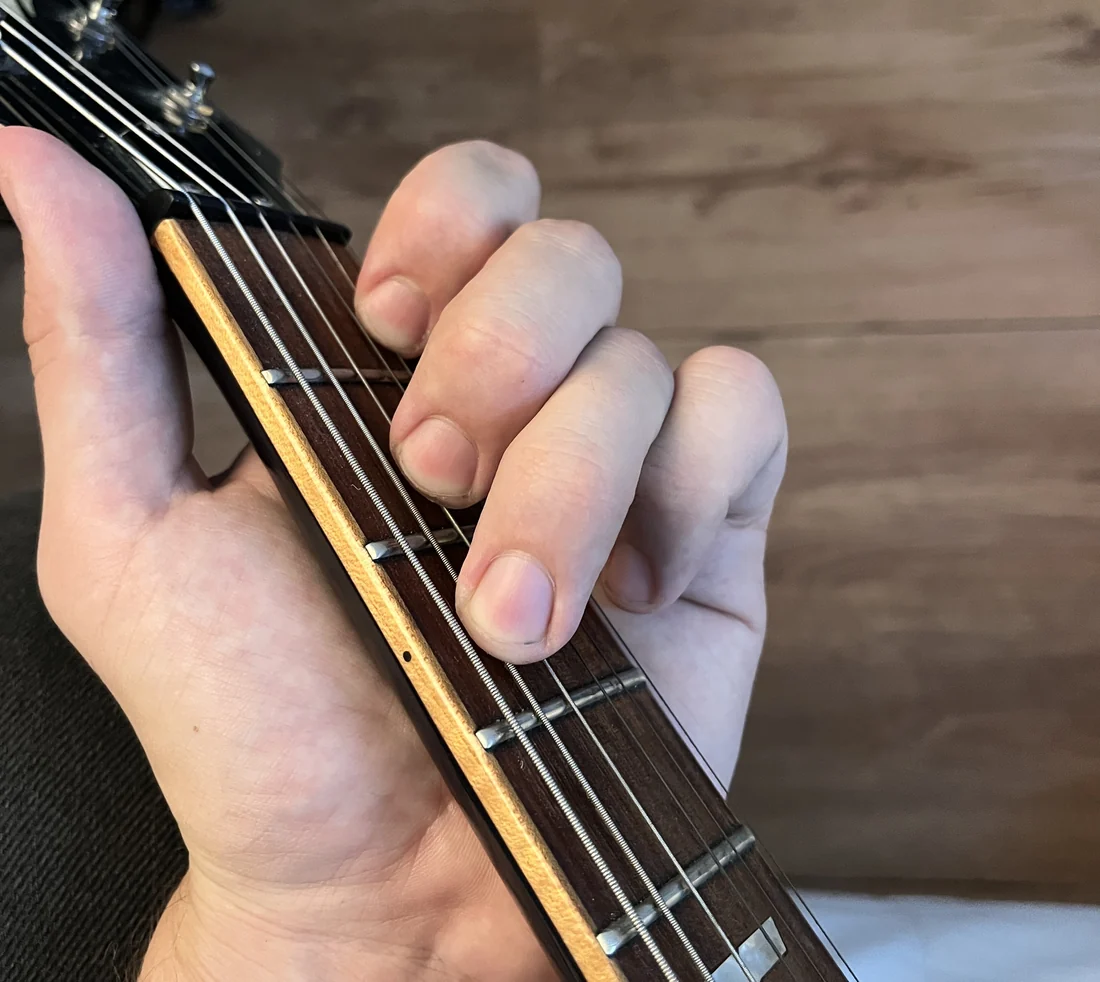
Find the exact contact point
Strumming the whole chord hides the cause. Pick the A, D, G, B, and high E strings separately and stop on the first dull note.
Low E
Do not play this string in the standard open C shape.
A string
Ring finger, fret 3, close behind the fret.
B string
Index finger, fret 1, on the fingertip.
High E
Open. Give it space below the index finger.
Step by step
1. Build C without strumming
Place ring, middle, then index finger slowly.
2. Pick A through high E
Listen for the first string that sounds short or dull.
3. Curl the finger above it
Move onto the fingertip so its underside stops touching the next string.
4. Strum only after all five strings pass
The full chord is the final check, not the diagnostic test.
Use finger angle before force
The C shape needs curved fingers so the open strings have space. Pressing harder with a flat finger usually mutes more strings.
Useful next pages
Common questions
Why is the high E string muted in my C chord?
The index finger on the B string is probably lying too flat. Curl it onto the fingertip so the open high E string has space.
Should I play the low E string in a C chord?
Not in the standard beginner C shape. Start the strum from the A string.